
Why Every Manufacturer Needs an AI powered Project Office

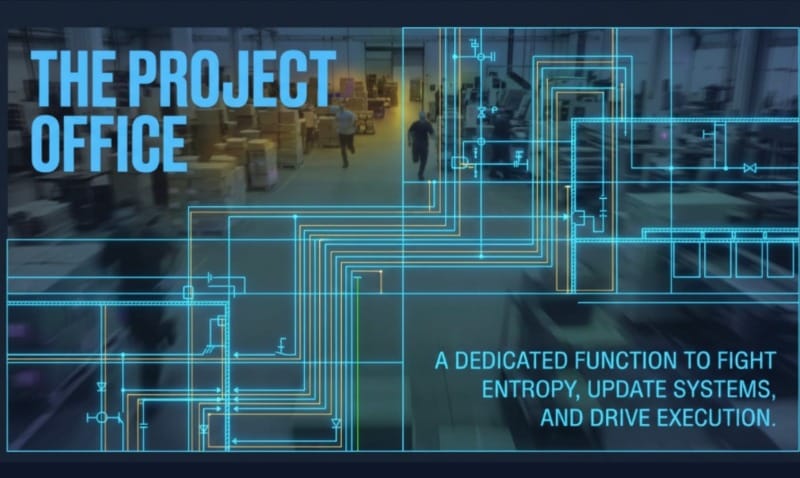
In the high-stakes world of manufacturing, there is a quiet force that separates companies that scale from those that slowly stall.
It isn’t just machinery, raw materials, or even talent.
It’s something far less visible — and far more powerful: the Project Office (PO).
If you are running a manufacturing business — whether a large plant or a specialised operation — and you don’t have a dedicated function focused on continuously improving systems, processes, and execution, it’s worth asking why.
Without a Project Office mindset, growth tends to flatten. Worse, operations quietly degrade over time as small inefficiencies compound, documentation decays, and today’s “temporary fixes” become tomorrow’s permanent constraints.
The Entropy Trap: Why “Business as Usual” Is Dying
Manufacturing is, at its core, a battle against entropy.
Machines wear down.
Processes drift.
Documentation goes stale.
Tribal knowledge walks out the door.
If you aren’t actively pushing forward, you are moving backward — even if things appear stable on the surface.
Early in my career, I worked in a project office at a soap factory. Everything from a new Factory Automation system to documenting the Wiring of the Cabinets was in scope.
We had severals skills on the floor, Engineers mainly who could look at process and systems and people and drive the fight against entropy and legacy.
That experience shaped how I still think about manufacturing operations today.
Outsource Labour, Not Logic
One of the most common mistakes manufacturers make is treating the Project Office as a luxury that can be outsourced.
You can — and often should — outsource execution:
specialist vendors, integrators, engineers, and implementation partners all play an important role.
But the Project Office itself must remain internal.
You can outsource hands.
You cannot outsource understanding.
A PO needs people who live inside the business — who can walk the floor, talk to operators, notice workarounds, and understand the cultural and operational nuances no external consultant ever fully sees.
This internal team owns the logic of the business:
how systems connect, how decisions are made, and how tools like ERP, planning, and reporting should serve the operation rather than constrain it.
A Greenhouse for Graduates and Future Leaders
A well-run Project Office is also one of the most effective talent development environments in a manufacturing business.
It is a natural home for graduates and early-career professionals — people with energy and curiosity, but limited exposure to how a business actually works end to end.
Inside a PO, they gain a rare 360-degree view:
- Analysis and documentation — understanding how the business truly operates, not how it’s described in theory
- Supplier and partner coordination — learning how external ecosystems function
- Technical experimentation — improving systems without disrupting live production
Over time, Project Offices quietly produce some of the strongest operational leaders in an organisation — people who understand both strategy and execution.
AI: The Force Multiplier for Small Teams
Historically, the biggest barrier to a Project Office — especially for smaller manufacturers — has been cost.
AI fundamentally changes that equation.
AI doesn’t replace the Project Office; it amplifies it.
- Bridging skills gaps
A junior team member, augmented with AI, can analyse data, draft documentation, and surface insights that once required senior specialists. - Turning systems into decision engines
AI can interpret complex operational and manufacturing data and translate it into plain-language recommendations — transforming ERP and reporting tools from static databases into active decision support. - Lowering the cost of experimentation
AI enables simulation, scenario testing, and rapid prototyping before a single machine is adjusted — dramatically reducing the cost of “trying”.
In practice, AI turns the Project Office from a reporting function into a continuous improvement engine — one that never gets tired of asking, “Why does this work like this?”
Optimise or Degrade
If your year-on-year improvements are marginal,
if the same problems keep resurfacing,
or if progress feels harder than it should…
You’re likely missing a Project Office mindset.
You don’t need a large department to begin.
You need:
- One strong anchor person
- A few ambitious graduates
- The discipline to own your systems
- And the right AI tools to extend your reach
Don’t let chaos become your default setting.
Build the function that exists to make tomorrow’s work easier than today’s.
Build your Project Office, powered by AI and AI Agents
See how we put AI Agents to work with ERPNext and other ERP's and CRMs with MindFront and SynthGrid
https://www.imbila.ai/mindfront-ai/