
What Actually Happened With Clawdbot → Moltbot
There's been such wild AI hype around ClawdBot that I thought we should cover it in some more detail...

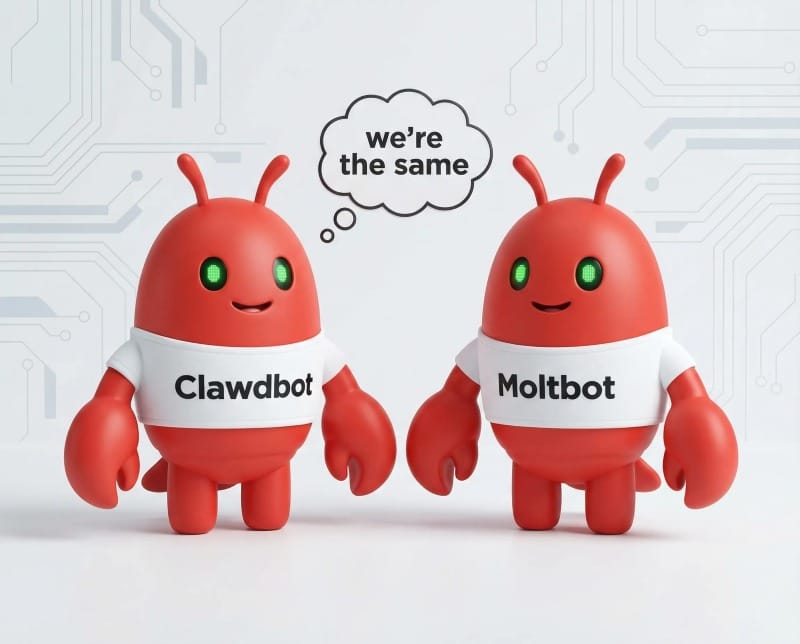
Between 25–27 January 2026, Clawdbot went from an obscure open-source side project to one of the most talked-about AI tools on the internet — and just as quickly, became a cautionary tale.
From Viral Breakout to Forced Rebrand
Clawdbot, created by independent developer Peter Steinberger, exploded across X, Hacker News, and LinkedIn after being positioned as “the AI that actually does things.” Within days it attracted 40,000+ GitHub stars, triggered widespread demos, and even coincided with a short-term bump in Cloudflare’s share price as users spun up local infrastructure to run it.
On 27 January, amid peak hype, Clawdbot was forced to rebrand to “Moltbot” following a trademark complaint from Anthropic, whose Claude models power many default setups. The rename was not voluntary, but it didn’t slow adoption — if anything, it amplified visibility.
Why People Got Excited
Moltbot struck a nerve because it crossed a line most AI tools hadn’t:
- It runs continuously, not just when prompted
- It integrates directly into WhatsApp, iMessage, Slack, Telegram, etc.
- It can read files, execute commands, control browsers, and manage workflows
- It’s self-hosted and open-source, appealing to builders who want control
In short: this felt less like a chatbot and more like an AI junior employee with real system access.
The Reality Check: Serious Security Fallout
Almost immediately, security researchers raised red flags.
Within days:
- Hundreds of Moltbot instances were found exposed to the public internet with no authentication
- A configuration bug allowed remote access to admin interfaces
- Sensitive data (API keys, messages, credentials) was often stored unencrypted on disk
- The plugin ecosystem had no review process, creating supply-chain risk
Several respected security figures went as far as calling Moltbot “functionally equivalent to installing malware on your own machine” if misconfigured.
The consensus across expert commentary was blunt:
Powerful idea. Extremely early. Not safe for non-experts.
So… Breakthrough or Hype?
The honest answer is both.
Moltbot demonstrated something important:
#Agentic AI — software that can observe, decide, and act across real systems — is no longer theoretical.
At the same time, it exposed how fragile and dangerous that power is without guardrails. Running an AI with full system access collapses decades of security assumptions, and the tooling ecosystem is nowhere near ready for mainstream use.
Why This Still Matters
Even critics agree on one thing: this is a preview of where AI is heading, not a gimmick.
Moltbot didn’t fail because the idea was wrong — it failed because the industry hasn’t yet figured out how to make agentic AI secure, auditable, and governable. That gap is exactly where the next wave of serious platforms, standards, and enterprise-grade tooling will emerge.
The hype will fade.
The direction won’t.
Source material drawn from consolidated reporting and analysis, Jan 25–27 2026