
The Maths of One Plus One

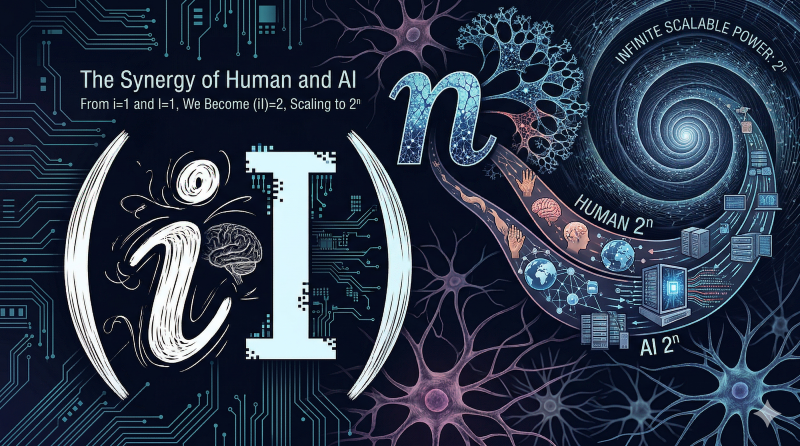
One human plus one AI equals two. But two doesn't stay two. It scales to the power of n — where n is every new skill the AI absorbs, every system it connects to, every pattern it learns from the last task. 2ⁿ. Not addition. A completely different curve.
The principle is simple. Give one person their own AI — not a shared chatbot, but an agent that knows their ERP, their data, their role — and what used to require a department becomes a solo operation. Then make the tooling compound. Every integration pattern gets reused. Every query template carries forward. Every build makes the next one faster.
McKinsey found that 92% of companies plan to increase AI spending, but only 1% consider themselves mature. The gap isn't budget — it's that most AI implementations don't compound. They're one-off pilots, disconnected chatbots, proof-of-concepts that prove nothing. The exponent never kicks in.
When the tooling does compound, the results look different. A manufacturing demo with six role-specific AI agents connected to a live ERP — procurement, sales, quality, inventory, production, finance — each handling natural language queries against real data. Built in minutes, not months. A Sage X3 analytics suite for a distribution company — customer dashboards, sales order tracking, AI-generated reports wired to a live GraphQL API. Also minutes. The second was faster than the first because the platform had already learned from it.
These are early demos, not finished products. But the speed is the signal.
For South African mid-market businesses, this matters. A Shoprite supplier in Durban on SAP Business One. A furniture manufacturer in Johannesburg on ERPNext. A distributor in Cape Town on Sage X3. None of them can afford a ten-person data team. All of them have one sharp operator who knows the business cold. Give that person their AI and the constraint flips — from "we can't afford to build this" to "this took an afternoon." The rand cost of custom integration used to make it impossible. The speed of compounding tooling makes it accessible.
The human brings judgment, context, the instinct for when numbers feel wrong. The AI brings speed, memory, the ability to query everything at once. Neither scales alone. Together, they're 2ⁿ. And n is still small — a handful of integrations, a few reusable skills, rough edges everywhere. But 2¹ is 2. 2⁵ is 32. 2¹⁰ is 1,024. The curve gets interesting fast.
One person. One AI. To the Nth.
Follow along at 2nth.ai.