
The $16 Billion Bluff
How AI Is Toppling the Consulting Pyramid and Ending Artificial Scarcity

1. The National Icon That Fell From the Sky
In the 1990s, Swissair was more than an airline. It was a national symbol. Known as “The Flying Bank,” it represented Swiss precision, prudence, and financial stability. Shares were gifted to children as long-term investments. It was considered untouchable.
By October 2001, it was bankrupt.
The collapse did not begin with reckless pilots or mechanical failure. It began with strategy.
After Switzerland rejected entry into the European Union, Swissair found itself isolated from EU airline alliances. To solve this, the company turned to McKinsey & Company.
The proposed solution became known as the “Hunter Strategy”: acquire minority stakes in struggling European carriers and stitch together a network from the outside.
On paper, it looked elegant. In reality, it was structurally flawed.
EU law prohibited non-EU airlines from taking majority control. Swissair inherited the losses of failing airlines like Sabena and LTU but lacked the authority to restructure them. The debt accumulated silently. When fuel prices rose and demand softened, the financial structure imploded.
By 2001, a KPMG audit revealed a staggering imbalance: roughly $17 billion in debt supported by just $555 million in equity — a 30:1 debt-to-equity ratio.
Swissair collapsed.
McKinsey collected its fees.
That asymmetry is important.
Because what is being disrupted today is not consulting advice.
It is the economics that made that advice profitable.

2. The Pyramid Was the Product
For decades, elite consulting firms operated on a simple economic truth formalized by Professor David Maister: a consulting firm must target roughly 70% gross margins to sustain its partnership model.
This margin requirement shaped everything.
The traditional hierarchy — Analyst → Associate → Engagement Manager → Partner — is not merely an org chart. It is a leverage engine.
A junior consultant might cost the firm $150,000 in total compensation but generate more than $400,000 in revenue. A partner overseeing ten such consultants extracts surplus from each layer below.
This is not malpractice. It is a design.
The pyramid works because:
- Research is labor-intensive.
- Institutional knowledge is locked inside the firm.
- Frameworks are proprietary.
- Structured synthesis requires time.
- Slide production consumes hours.
Clients pay for accumulated human effort at scale.
But what happens when human effort is no longer the bottleneck?
 Hans Peter Bech
3. Lily and the Collapse of Information Scarcity
In July 2023, McKinsey launched “Lily,” an internal AI platform trained on more than a century of the firm’s proprietary casework, transcripts, and frameworks.
Within 18 months, roughly 75% of its 45,000 consultants were using it monthly.
Consider what that means.
Tasks that once required:
- Days of archive searches
- Manual precedent gathering
- Cross-case comparisons
- Structured workstream design
can now be synthesized in hours.
Slide formatting — once consuming significant junior bandwidth — is automated.
Engagement managers refine AI outputs instead of assembling them from scratch.
Then came the quiet revelation: McKinsey reduced headcount by thousands without reducing revenue.
That is not a cyclical adjustment.
It is structural exposure.
If revenue remains stable while labor shrinks, then labor was never the true source of value.
Scarcity was.
And AI eliminates scarcity.
https://www.mckinsey.com/about-us/new-at-mckinsey-blog/meet-lilli-our-generative-ai-tool
4. The Great Inversion: Software Over Services
For decades, consulting firms were prime contractors.
They owned the client relationship. Software vendors were implementation details.
Today, that relationship is reversing.
Software scales exponentially.
Services scale linearly.
If a consulting firm wants an additional $1 million in revenue, it must hire more people.
If a software firm wants that same $1 million, it sells additional licenses.
This shift in power is visible in firms like Palantir, which operates with profit margins near 50% and a “Rule of 40” score that outpaces most scaled service firms.
In large government and defense contracts, technology providers increasingly hold the prime contract. Consulting firms compete for implementation roles.
The hierarchy has flipped.
Services are becoming downstream of software.
5. What AI Actually Kills
AI does not eliminate expertise.
It eliminates:
- Generalist synthesis
- Research aggregation
- Framework recall
- Structured slide construction
- Billable-hour justification
These were once premium capabilities.
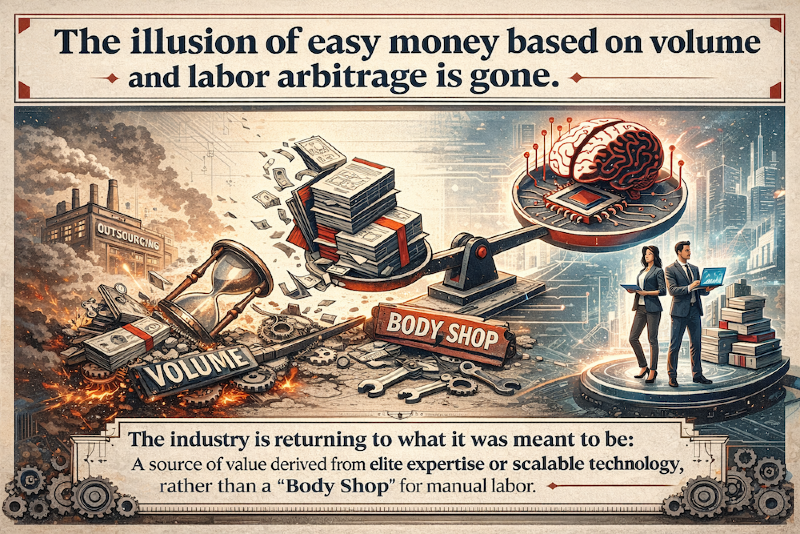
They are now commodities.
The new scarcity is different:
- Judgment under uncertainty
- Domain-specific lived experience
- Execution risk
- Accountability
- Skin in the game
The era of charging for structured thinking alone is ending.
6. The Bifurcation of the Industry
Consulting is not disappearing. It is splitting.
Path One: Elite Boutiques
Small, hyper-specialized teams delivering working prototypes, proof-of-concepts, and measurable outcomes.
Path Two: Software-Wrapped Consulting
Firms that build repeatable systems and use AI to scale domain expertise.
Path Three: The Traditional Pyramid
Large cohorts of generalists billing hours for synthesis work.
Path Three is shrinking.
Entry-level hiring in major firms has already fallen significantly. The “prestigious grind” — once the training ground of the generic elite — is precisely the layer being automated.
7. The End of Artificial Scarcity
For decades, access to structured intelligence required gatekeepers.
If you wanted precedent, you hired a firm.
If you wanted frameworks, you paid for them.
If you wanted synthesis, you bought billable hours.
AI dissolves that barrier.
When a system can ingest decades of institutional memory and generate structured outputs instantly, the economic foundation of artificial scarcity collapses.
The question is no longer:
“How do we hire smart people to think for us?”
It is:
“What remains valuable when intelligence is abundant?”
Swissair’s collapse was a warning about strategy divorced from execution.
The consulting pyramid now faces its own version of that reckoning.
The ladder still exists.
But its lower rungs are being programmed out of existence.
And when scarcity disappears, so does the illusion that sustained it.