
Most companies are using AI to automate tasks. The ones pulling ahead are building skills.

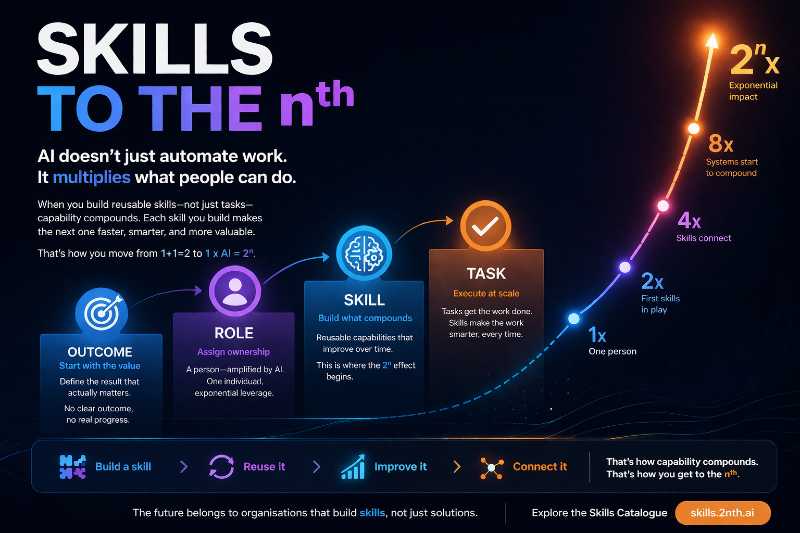
That's the difference between efficiency and leverage.
Most AI implementations stall for the same reason. The team automates a task — generate a report, summarise a document, write an email — and it works. Then they automate another. And another. Six months later, nothing connects. Nothing compounds. The backlog of one-off prompts grows, but the organisation isn't measurably smarter.
The problem isn't the technology. It's the unit of work.
A task gets done once. A skill gets reused. A task saves time on Tuesday. A skill changes how the team operates from Tuesday onward. That distinction — between a disposable task and a durable skill — is where most AI strategies quietly fall apart. And it explains why two companies using the same models can have wildly different results.
Peter Steinberger figured this out early. When he built OpenClaw — the open-source AI agent that hit 100,000 GitHub stars in three months — he didn't organise it around prompts or chat threads. He organised it around skills. Each skill is a reusable module the agent can load, combine, and improve. The community has built over 13,000 of them. The agent can even write its own. Steinberger's insight was structural: give an AI a task, it does a task. Give it a skill, it builds capability. That architecture is why OpenClaw went from a weekend hack to the fastest-growing agent framework in history.
That compounding is what we're building at 2nth.ai. The name comes from the maths: one person plus AI doesn't equal two. It equals 2ⁿ — where n is every skill you build, every system you connect, every pattern you reuse. But the exponent only kicks in when you stop thinking in tasks and start thinking in skills.
The framework is simple. Outcome, then role, then skill, then task. Most teams start at the bottom — "use AI to draft this email" — and never work upward. The ones pulling ahead start at the top: define the outcome, assign ownership to a role, then build the reusable skill that makes the task almost incidental.
Consider what this looks like inside a South African mid-market business. A logistics company in Durban doesn't need a chatbot that answers customer queries. It needs a freight exception skill — something that spots anomalies in shipment data, flags delays before customers notice, and improves every time it runs. Discovery doesn't need another report generator. It needs actuarial skills that compound across product lines. Shoprite doesn't need isolated store-level dashboards. It needs demand-sensing capabilities that learn from every location and transfer insight across the network. In each case, the skill is the asset. The task is just one expression of it.
The skill is the unit that scales. Not the prompt. Not the pilot. Not the chatbot.
This is also why so many AI "strategies" aren't strategies at all. A chatbot here, a copilot there, a few internal pilots — none of it accumulates. AI maturity isn't measured by adoption rates or how many tools you've deployed. It's measured by accumulation. Are your AI capabilities building on each other, or sitting in silos?
If the answer is silos, you're not behind. You're just early. And the next step isn't another pilot.
It's your first skill.
Start building at 2nth.ai — or explore what's possible at skills.2nth.ai.
Explore the Vision.. https://2nth.ai/vision