
AI Is Eating SaaS: Why the Subscription Era Is Ending
For two decades, Software-as-a-Service defined digital business. Now AI is turning that model inside out. From seat licensing and bloat to outcome-based pricing and ownership of data, the next revolution in software isn’t about subscriptions — it’s about sovereignty.

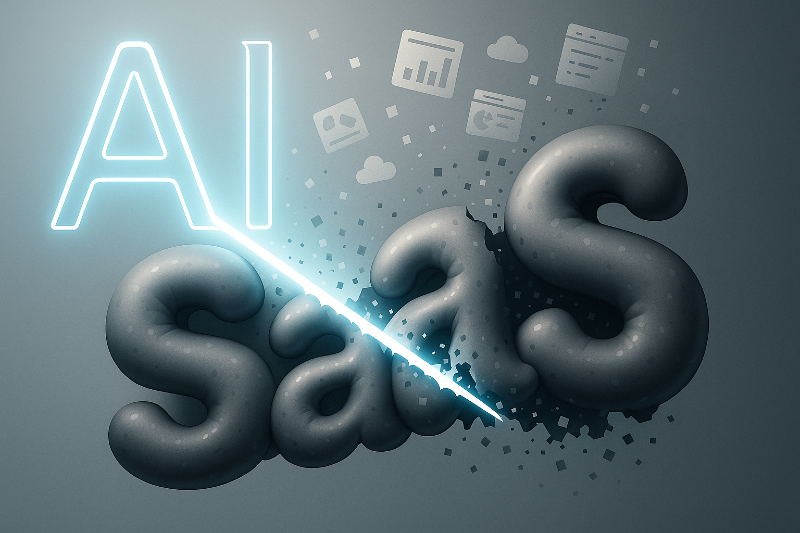
For two decades, Software-as-a-Service (SaaS) defined the rhythm of digital business.
Monthly subscriptions replaced boxed software, IT moved to the cloud, and “seat licensing” became the industry’s heartbeat.
Now AI is turning that heartbeat irregular.
The automation wave that once made SaaS inevitable is now threatening it.
The Return of Bloat
Thirty years ago, SaaS disrupted on-premise systems bloated by maintenance contracts and idle users. Ironically, SaaS has become the very thing it replaced.
- SaaS Fat: Companies keep paying for underused apps and idle seats. McKinsey’s 2025 data shows that only about a quarter of purchased licences are consistently used.
- Glorified Databases: Many platforms still rely on humans to feed them data, only to export it again for analysis.
- Low ROI: McKinsey found that while AI add-ons drive price hikes of up to 80 %, fewer than one-third of firms can show measurable return.
The SaaS model rewards expansion, not efficiency — and AI exposes that imbalance.
AI’s Two-Sided Pressure
AI is squeezing SaaS from both sides — demanding higher value while undermining its own business logic.
- The ROI Mandate
Bain & Company reports that enterprise buyers now expect automation to do the work, not just display the data. Platforms that can’t deliver outcomes are seen as shelf-ware. - The Pricing Paradox
The more AI automates, the fewer “seats” a company needs. Yet seat-based pricing remains the default.
EY’s 2025 paper Agentic AI: How SaaS Companies Can Embrace the Future warns that traditional subscriptions are “misaligned with value creation” and that hybrid or consumption-based models will soon dominate.
SaaS vendors face a choice: price for outcomes, or be priced out.
From Subscription to Sovereignty
The most valuable digital asset of the next decade won’t be software — it’ll be a company’s own intelligence layer.
Generative AI is making that possible:
- Custom Software on Demand: Kepler Cannon shows how natural-language tools now let employees build or clone internal apps without coding.
- Vendor Lock-in Weakens: Migration pain, once a moat for giants like Salesforce, is fading as AI automates data mapping and workflow replication.
- Headless Automation: Bain describes the shift from human + app to AI agent + API — autonomous systems that orchestrate work across platforms.
When your AI can build, integrate, and adapt software in real time, why rent features behind a login?
The Playbook for Leaders
AI isn’t an upgrade. It’s a new operating model.
- Audit your stack – Identify unused or redundant licences and map renewal dates.
- Reallocate savings – Use freed-up spend to build internal AI agents and secure data stores.
- Own your intelligence – Centralize knowledge under your own model instead of scattering it across vendors.
- Adopt outcome-based pricing – Work with partners who charge for results, not log-ons.
- Invest in adoption – McKinsey’s rule still holds: spend three dollars on change management for every dollar on model development.
A New Kind of Cloud
What’s coming isn’t the death of SaaS — it’s its digestion.
AI will absorb interfaces, rewrite pricing, and hand control back to the users who can generate what they need.
The winners won’t be those selling the most licences, but those helping businesses own their intelligence.
“Own the data. Lead on standards. Price for outcomes.” — Bain & Company, 2025
Sources & Further Reading
- Bain & Company — Will Agentic AI Disrupt SaaS? (2025)
- McKinsey & Company — Upgrading Software Business Models to Thrive in the AI Era (2025)
- EY — Agentic AI: How SaaS Companies Can Embrace the Future (2025)
- Kepler Cannon — The Future of SaaS: Innovation or Extinction? (2025)
See how we think AI platforms can reduce your SaaS costs with MindFront AI
 Craig Leppan (Imbila)